

Master the Jawaker Tarneeb bidding strategy in 2026 with proven trick calculations, partnership cues, and contract discipline to win competitive matches.
Every lost Tarneeb match on Jawaker traces back to the auction. Players blame bad luck, an uncooperative partner, or rigged deals. In reality, the loss happened three minutes earlier when someone looked at four trumps and an unsupported King, felt lucky, and declared an eight-trick contract.
Tarneeb is an unforgiving trick-taking game. When you win a bid, you shoulder total responsibility for your team's score. Overbidding drains your points, feeds free tricks to your opponents, and tilts your partner. Strip out the guesswork. A structured evaluation method lets you bid with mathematical accuracy and protect your ranking at competitive tables.

Jawaker Voucher
- -70%
Jawaker Voucher (Global) Jawaker 4250 Token
Buy NowUSD 0.99
USD 1.68
- -70%
Jawaker Voucher (Global) Jawaker 32500 Token
Buy NowUSD 4.96
USD 8.43
- -70%
Jawaker Voucher (Global) Jawaker 70000 Token
Buy NowUSD 9.91
USD 16.85
- -70%
Jawaker Voucher (Global) Jawaker 150000 Token
Buy NowUSD 19.82
USD 33.70
- -70%
Jawaker Voucher (Global) Jawaker 230000 Token
Buy NowUSD 29.74
USD 50.55
- -70%
Jawaker Voucher (Global) Jawaker 400000 Token
Buy NowUSD 49.56
USD 84.25
- -70%
Jawaker Voucher (Global) Jawaker 525000 Token
Buy NowUSD 64.43
USD 109.52
- -70%
Jawaker Voucher (Global) Jawaker 805000 Token
Buy NowUSD 99.12
USD 168.50
The Core Math: Calculating Tricks Before You Speak
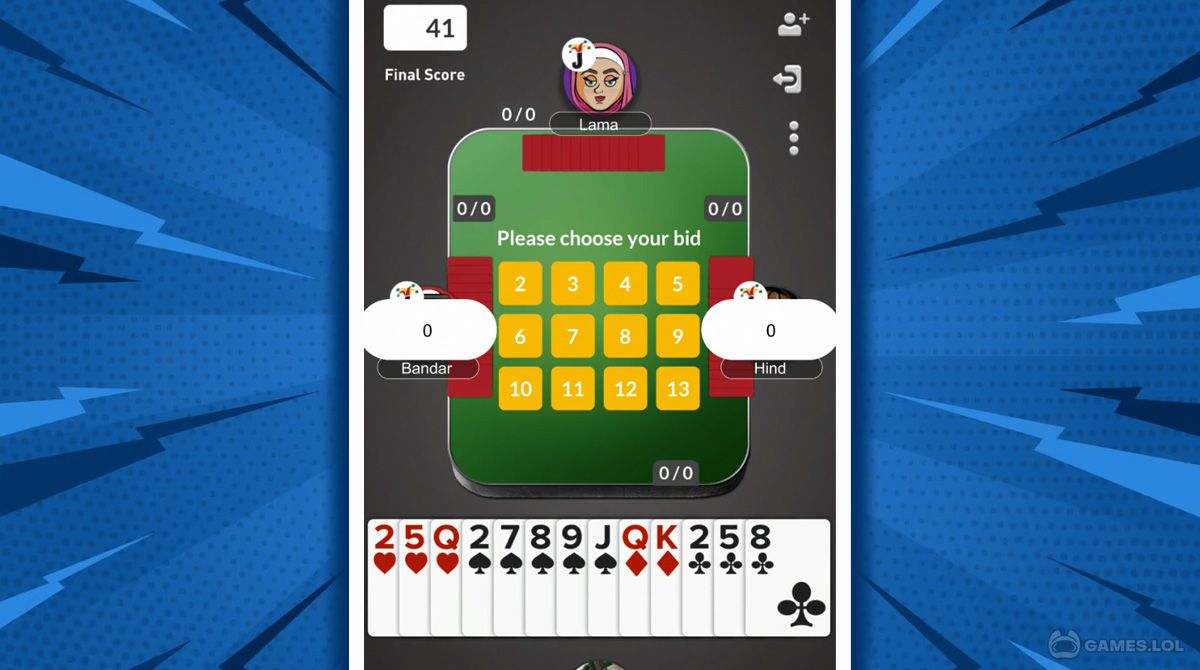
Standard Tarneeb bidding requires the auction to open at seven tricks (labeled "1" above the book of six) and caps out at thirteen tricks, known across the Levant as "Kaboot" or "Kabbout." The action starts to the dealer's right and proceeds counterclockwise. If you cannot produce seven tricks between your hand and an average partner distribution, pass.
A dependable evaluation formula counts one trick per outside Ace and one trick for every trump held past the third.
If you hold five trumps headed by the Ace and King, you cannot count five tricks. You count two tricks for trump length (five minus three), plus your top honors. Add an outside Ace of Hearts, and you have roughly three reliable tricks on your own board. Your partner must supply the remaining four to make an opening call of seven viable.
Expected Declarer Tricks = (Outside Aces) + (Trumps Held - 3) + (Adjustments for Voids/Singletons)
Side honors like unsupported Kings or Queens do not represent baseline tricks during the auction. A King without an Ace or strong suit length is fifty-fifty at best; an opponent holding the Ace behind you will capture it on the opening round. Count Kings as a half-trick only if supported by the Queen or two low cards in the same suit.
Standard Tarneeb vs. Syrian 41: Understanding Scoring Swings
Rules vary across Jawaker game lobbies, and confusing standard Tarneeb with Syrian 41 will ruin your bankroll. In standard Tarneeb, the declaring partnership tries to hit its contract while the defenders attempt to set them. Syrian 41 completely alters the auction mechanics and punishes bad bids twice as hard.
The following table breaks down exact scoring penalties and contract rewards between the two major variants played on the platform.
| Contract Outcome | Scoring Adjustment | Strategic Impact on Player Bids |
|---|---|---|
| Standard Tarneeb (Bid Made) | Actual tricks won | Team logs all tricks captured; defenders receive zero points. |
| Standard Tarneeb (Bid Failed) | -Bid value deducted | Declaring team loses declared tricks; defenders add all tricks they won. |
| Standard Tarneeb (Bidded 13 Won) | +26 points | Full Kaboot bonus awarded for declaring and taking all 13 tricks. |
| Standard Tarneeb (Unbidded 13 Won) | +16 points | Bonus awarded when a team sweeps 13 tricks without calling Kaboot. |
| Standard Tarneeb (Bidded 13 Failed) | -16 points | Severe penalty applied to declarer for missing a 13-trick contract. |
| Syrian Tarneeb 41 (Bid Failed) | -2x Bid value deducted | Double deduction penalty transferred directly to the defending team. |
Scoring outcomes across standard Jawaker Tarneeb matches and Syrian 41 variants.
Notice the brutal reality of Syrian 41: missing your contract deducts twice the number of declared "Lamas" (tricks) from your score and awards those points straight to the opponents. Syrian 41 also enforces individual bidding where each player makes a single call between 2 and 13 tricks. You do not choose the trump suit in Syrian 41; the trump suit is determined by the color of the exposed final card from the deal. If the sum of all four players' bids fails to reach 11 tricks, the round is canceled immediately and cards are redealt.
Matches terminate when a partnership reaches 31, 41, or 61 points depending on room settings. If you play high-stakes rooms, ensure your balance is funded by grabbing a Jawaker Voucher so unexpected game penalties do not lock you out of ranked tables.
When to Pass in Jawaker Tarneeb
Passing is an active tactical weapon, not an admission of defeat. Knowing when to step back protects your team from catastrophic negative rounds.
Pass immediately when your trump suit is fragmented. A holding such as King-Jack-8-4-2 may look like five trumps, but without the Ace or Queen, you will lose trump control the moment opponents force your hand. If they hold the Ace and Queen, they will let you lead into their honors, stripping your length while maintaining master cards over your partner.
Pass when your hand contains flat 4-3-3-3 distribution. Balanced shapes produce fewer tricks than hands with singletons or voids. A singleton allows you to ruff losing cards from your partner early, converting a small trump card into an extra trick. A 4-3-3-3 hand offers zero ruffing value.
Pass if the current bid exceeds eight and you do not possess at least two outside stoppers (Aces or protected Kings). Relying on a partner to carry three or four tricks on contested auctions is how contracts collapse by three tricks.
Avoiding Fatal Tarneeb Partnership Bidding Mistakes
Online play creates communication barriers because table chat and unauthorized signaling are prohibited. You must read your partner's bids through mathematical inferences rather than intuition.
Here are the four recurring bidding mistakes to eliminate:
- Overbidding into Suit Misfits: A long side suit looks appealing, but if your partner is void or holds only a single card, opponents will trump it the moment you cash the Ace. Trick potential evaporates without complementary length from your partner.
- Stealing Bids with Redundant Values: If your partner bids seven and an opponent passes, raising to eight with a balanced hand that was already factored into partner's expectations accomplishes nothing except increasing your team's failure liability.
- Ignoring Dealer Position Nuance: In traditional physical games, some house rules allow the dealer to match the high bid to claim trump rights. On Jawaker, that privilege does not exist; every bid must strictly exceed the previous number. Plan auction escalations knowing you cannot steal a tie from the dealer seat.
- Cashing High Outside Honors Early: Once the auction closes and play begins, declarers often rush to cash side Aces before pulling trumps. This mistake allows opponents to ruff your highest winners with low trumps, flipping the contract completely.
If you want to play consistently at higher ranks without interruptions, take time to secure your Jawaker Voucher ahead of competitive tournament sessions.
Declarer Execution: The First Three Tricks
Winning the bid gives you control of the opening lead. What you do across tricks one, two, and three determines whether your contract succeeds.
Your first duty is extracting enemy trumps. Lead your highest trump immediately. If you hold Ace-King-Queen, pull two or three rounds of trumps without delay. Drawing trumps prevents defenders from using low cards to cut down your side-suit Aces and Kings later in the hand.
Only delay drawing trumps if you must cross-ruff a short suit in your partner's hand before clearing the board. Even then, do not delay past trick two unless you have tracked every card meticulously.
Watch the discards during trump rounds. If an opponent shows out on round two, the remaining trumps sit entirely with the other defender. Adjust your line immediately by finessing through the long defender rather than leading from the top.
Trick 1: Lead high trump honor (strip defensive cards)
Trick 2: Lead second trump honor (confirm suit distribution)
Trick 3: Clear remaining master trumps OR establish longest side suit
Defensive Counter-Play: Forcing Trumps and Sequence Leads
When your opponents win the contract, your objective shifts from accumulating volume to forcing declarer off balance. The best defense attacks the declarer's weak suits.
| Defensive Opening Lead | Primary Tactical Goal | Risk Level |
|---|---|---|
| Top of Honor Sequence (K from K-Q) | Establishes safe winners without sacrificing honors | Very Low |
| Leading Partner's Bid Suit | Concentrates combined defensive firepower | Low |
| Short Suit Singleton | Sets up partner ruff opportunities early | Medium |
| Low Card from Unsupported Ace | Traps partner; declarer wins cheap trick | High (Avoid) |
Strategic breakdown of opening defensive leads against declared Tarneeb contracts.
Leading from a sequence like King from King-Queen-Jack establishes tricks naturally. If the declarer ducks, your Queen remains high. If the declarer wins with the Ace, your remaining honors are promoted to master cards.
Never lead an unsupported Ace on defense during trick one unless you hold the King behind it. Leading a lone Ace gives the declarer two promoted cards if they hold King-Queen in that suit. Keep your Ace as a stopper behind declarer's run.
If your partner bid during the auction before passing, lead their suit. Respecting your partner's bid suit pools your collective strength and frequently strips the declarer of entry cards back to their hand.
When holding a master trump on defense (like the Queen or King after Ace has dropped), do not play it early. Hold your master trump in reserve. Wait until the declarer tries to run their long side suit, then cut in to break their sequence and force undertricks.

Jawaker Tarneeb Tournament Tips 2026
Tournaments on Jawaker demand strict bankroll preservation and adaptive bidding styles. In single-elimination formats, standard rubber strategies are too passive.
Calculate your table position at all times. If your match target is 31 points and your team sits at 24 while the opposing team sits at 29, standard conservative play will lose you the match. You must push bids to seven or eight on borderline hands to prevent opponents from buying a cheap contract and scoring the final two points.
Conversely, when leading 28 to 15 in a 31-point room, never bid past seven. Make the defenders take the initiative. If they overbid out of desperation, defend soundly, collect your defensive tricks, and let their penalty score hand you the victory.
For regular tournament grinders, managing entry tickets and table access requires planning. You can pick up a Jawaker Voucher directly to maintain your tournament balances throughout competitive weekends.
Jawaker Tarneeb Counting Trump Cards and Tracking Suits
Ranked performance hinges on jawaker tarneeb counting trump cards. You cannot guess how many trumps remain on the table; you must know with absolute certainty.
There are 13 cards in each suit. If you hold 5 trumps and your partner shows 2 during the first round, 7 trumps are visible to you. That leaves 6 trumps split between the two opponents. When trick one completes and both opponents follow suit, that removes 2 more cards from the wild pool (4 remaining). If trick two sees one opponent discard an off-suit card, the final 3 enemy trumps sit entirely in one opponent's hand.
If manual counting feels difficult, pay attention to card tracker tools. On web browsers, third-party extensions like the Jawaker Card Counter monitor played cards by suit and display stacks right beside the table. While handy for training your eyes, do not rely on browser extensions as a crutch. Mobile apps and tournament clients require mental tracking.
Group suits mentally into played honors: Ace, King, Queen, Jack. If an opponent leads the 10 of Spades and you hold the King, ask yourself where the Ace and Queen sit. If your partner does not cover with the Ace, assume the fourth seat holds it. This deductive habit prevents you from throwing away high cards on defense.
FAQ
What is the minimum bid required in standard Jawaker Tarneeb?
The auction opens at seven tricks, which is often shown simply as "1" because it represents one trick beyond the base book of six. Bids increase incrementally up to thirteen tricks, known as Kaboot.
How do I calculate my tricks before placing a Tarneeb bid?
Count one trick for each outside Ace you hold, and count one trick for every trump beyond your third card. Adjust your total upward if you hold solid sequences like King-Queen or side-suit voids that allow early ruffing.
What happens to our score if we miss our Tarneeb contract?
Your team loses points equal to the total number of tricks you declared, while the defending team adds all tricks they captured to their score. In Syrian 41, the penalty is doubled and transferred directly to the opponents.
Why is Syrian Tarneeb 41 riskier than standard Tarneeb?
Syrian 41 enforces individual bidding between 2 and 13 tricks with zero trump-selection rights for the declarer. A failed bid costs double the declared tricks, which are given directly to the opposing team's score.
What should a declarer play immediately after winning the bid?
Declarers should lead top trumps during the first two to three tricks to strip defenders of their trump holdings. Clearing trumps protects your side-suit Aces and Kings from getting ruffed later in the hand.
How can defenders break a declarer's high Tarneeb contract?
Defenders should lead suits where their side holds shortness to force the declarer to spend trumps early, and hold a master trump in reserve. Avoid leading unsupported honors away from Aces directly into declarer's position.
What rule applies in Syrian 41 if all players bid conservatively?
If the cumulative sum of all four bids across the table is less than 11 tricks, the round is annulled. The cards are gathered, shuffled, and redealt without any score changes.
Final Verdict: Bidding Discipline Beats Aggression
Aggressive bidding wins highlights; disciplined bidding wins tournaments. In competitive Tarneeb, the player who pushes marginal hands to eight tricks without outside stoppers is a liability to their partnership.
Anchor your bids in mathematics. Count your outside Aces, assess your trump length past three, read your partner's passes, and pull trumps the second you gain the lead. Follow these fundamentals, and your Jawaker ranked tables will turn into steady, profitable wins throughout 2026.

Community
Comments